

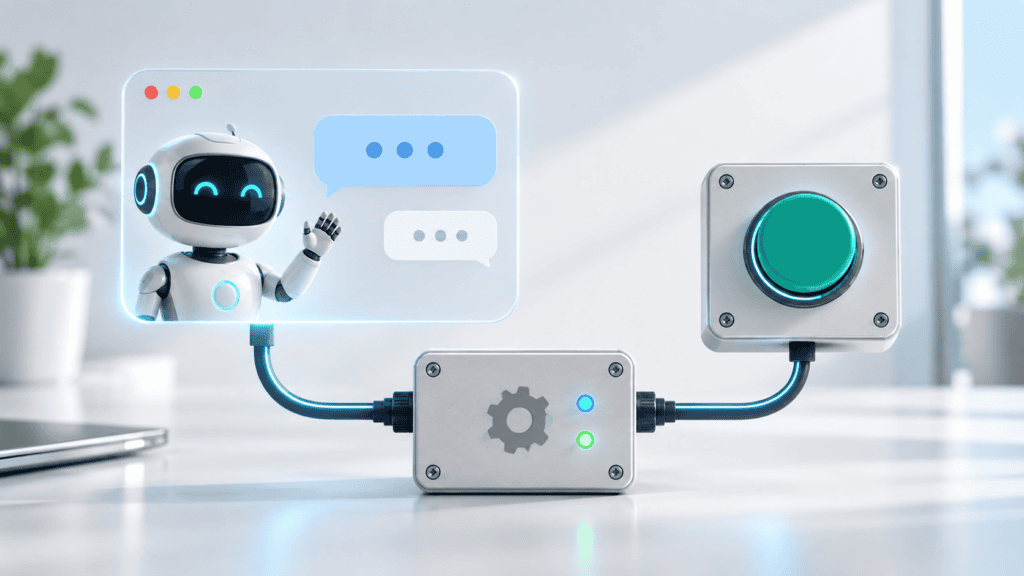
The loudest idea in AI product design right now is “chat is the new UI — just let the agent do it.” At Tessa I’ve spent the last stretch building ROCCO, an AI route manager where you run the whole app by talking to it. So I’m about as bought-in to agent-first interfaces as anyone alive. And here’s my contrarian take on agentic UI: put a plain, boring button on everything anyway. On purpose. The button isn’t the fallback. It’s the feature.
The demo that fooled the whole room
Here’s what taught me. For a while, one of ROCCO’s setup panels only existed inside the conversation. It appeared when the agent decided to open it — you’d ask, it would surface exactly the right controls, and the room nodded. It was the platonic ideal of agentic UX: no menus, no clutter, the interface assembling itself around your intent in real time.
Then a real user needed it. Our users aren’t AI early adopters chasing the newest chatbot. They’re people who spent twenty years driving collection trucks and now run routing for a city. This one needed to change a single setting — and he simply couldn’t. There was no button. Nothing to click. The only way in was knowing the precise phrase that would summon the panel. He knew exactly what he wanted. He just didn’t know the magic words. We’d built a trap and called it magic.
That’s the failure mode nobody demos, because a demo is run by the person who wrote the magic words.
When chat is not the UI
An agent-only interface fails the exact moment a user knows what they want but not the phrase to conjure it. And that moment is not an edge case — for AI for non-technical users, it’s Tuesday. Conversation is a wonderful on-ramp for open-ended intent: “why is this route running long?” is a great thing to ask out loud. But “toggle this one setting I can already picture in my head” is not a conversation. It’s a click. Forcing it through chat is slower, not faster.
This is the part the “chat is the new UI” crowd skips. Conversational UI design is genuinely great at ambiguity and terrible at precision. The instant a user’s intent gets specific and structured, a form beats a sentence every time. Good agentic UI knows the difference and gives you both doors. Chat is not the whole UI — it’s one lane of it.
So it became a rule at Tessa: every capability the agent can perform must also have a manual click-path — a menu entry to reach the surface, and real fields and buttons to act on it. The agent is a fast lane. It is never the only lane.
Designing AI agents that don’t hold users hostage
If you’re designing AI agents as a product’s front door, here’s the discipline I’d hand you. Build the manual UI first, then let the agent drive it — same panels, same buttons, same underlying actions, just triggered by language instead of a mouse. When the agent opens that setup panel for you, it’s opening the identical thing you could have opened yourself. Nothing lives only inside the conversation. Nothing is reachable by magic words alone.
That inversion is the whole trick of durable AI UX. An agent-first interface earns trust by never being the only interface. The agent handles the ambiguous, exploratory, “just do it for me” work. The button handles the precise, “I know exactly what I want” work. Ripping the button out to look more futuristic doesn’t make the product smarter — it just moves the wall your user hits from never to the first time they know their own mind.
The button isn’t a concession to the skeptics in the room. In an agentic UI, it’s the floor that makes the magic safe to stand on.


